




Climate Action
Climate change is a global challenge that transcends national borders.
Research on SDG13 - Climate Action
【Publications】

Figure 1 MUST SDG13 Paper Growth Trend

Figure 2 Number of MUST SDG13 Papers Published in Top 10% Journals
【Research Programs】
MUST SDG13 Research Projects | Department/College/Institute |
Dust climate related to mesoscale dynamics in the Martian atmosphere | SSI |
Communicating climate change risks: The social amplification effect | FA |
The impact of management's climate concerns on corporate ESG information disclosure decisions: Evidence from China | MSB |
Low carbon energy use
MUST compiles an annual sustainability report and records the consumption data of clean energy. Currently, the solar photovoltaic panels are expected to produce 1,049,712.75 KWh of clean and environmentally friendly electricity per year.
MUST completes university-wide carbon emission accounting and establishes the 2039 carbon neutrality pathway
To actively respond to climate change, Macau University of Science and Technology has completed a comprehensive accounting of the University's energy use and carbon emissions, and has formulated a clear carbon neutrality roadmap on this basis. The University has officially committed to achieving campus carbon neutrality by 2039, laying a solid data foundation for building a "zero-carbon campus". (For details, see https://sust.must.edu.mo/file/ghg-report.html)
1. Scientific accounting: building a complete carbon footprint inventory covering the three scopes
MUST's carbon accounting work strictly follows international standards and has established a complete carbon emission statistics system covering Scope 1, Scope 2 and Scope 3, comprehensively measuring the University's impact on the environment:
Scope 1: Direct emissions
Mainly derived from the fuel combustion of the University's own facilities, such as fossil fuel consumption by fixed sources (buildings and mechanical equipment); campus vehicles used by the University; fugitive emissions, etc.Scope 2: Indirect emissions
Mainly from the carbon emissions generated by purchased electricity. This is currently one of the main sources of carbon emissions in campus operations and is also the focus of the current emission reduction measures.Scope 3: Upstream and downstream indirect emissions
This scope covers all other indirect emissions related to University activities, such as purchased goods and services, commuting of staff and students, and waste disposal. Although accounting for this part is complex, MUST has incorporated it into long-term monitoring and management planning to comprehensively promote the low-carbon transformation of the supply chain and lifestyles.
2. Goal-oriented: taking multiple measures towards carbon neutrality by 2039
Based on detailed accounting data, MUST has formulated a series of specific and feasible energy-saving and environmental protection measures to systematically reduce carbon emissions.
Comprehensive electrification and power decarbonization: gradually phasing out fossil-fuel-dependent equipment on campus, shifting to clean energy such as electricity, and actively promoting green electricity procurement to reduce Scope 2 emissions at the source.
Expanding the application of solar photovoltaic panels: on the basis of the completed largest-scale solar carport in Macao, continue to expand photovoltaic power generation facilities, improve the self-sufficiency rate of clean energy, and directly reduce Scope 2 emissions.
Restricting the use of refrigerants and promoting energy-efficient products: strictly managing refrigerants with high global warming potential (controlling Scope 1 emissions), and giving priority to energy-efficient products in procurement to comprehensively reduce energy consumption.
By building a carbon accounting system covering the three scopes and implementing targeted measures, MUST demonstrates its determination to deeply integrate the concept of sustainable development into campus operation and management. The University will continue to advance these measures, not only to build a green and zero-carbon campus, but also to contribute the strength of science and technology and wisdom to the low-carbon transformation of society.
Environmental education measures
The first meeting of the Academic Committee of the National Field Scientific Observation and Research Station for the Coastal Ecological Environment of Macau was successfully held at Macau University of Science and Technology. Representatives from the Macau Environmental Protection Bureau, the Macau Science and Technology Development Fund, and various universities participated in the meeting. At the meeting, MUST shared the results of its cooperative research with the Macau government, local communities, and universities and formulated future plans. For more details, please see https://www.must.edu.mo/ceem/news/48709-article0116160606
Commitment to carbon neutral
MUST actively promotes sustainable development and reduces carbon emissions. It has set a goal to achieve carbon neutrality by 2039 and is committed to building a zero - carbon campus. (For more details, please see https://www.must.edu.mo/id-13630/article/view/id-30610.html). MUST began to calculate its carbon emissions in 2021. The emissions in the 2022/2023 academic year were approximately 16,000 tons of carbon dioxide equivalent, and the per - capita carbon emissions were less than 1 ton of carbon dioxide equivalent. To promote sustainable development, it plans to achieve the goal of campus carbon neutrality by 2039. (For more details, please see https://www.must.edu.mo/id-13630/article/view/id-30610.html).
Cooperation on Climate Change: Exploring Blue Carbon and Leading Standard-Setting
Macau University of Science and Technology actively pursues the United Nations Sustainable Development Goals (SDG 13 Climate Action and SDG 17 Partnerships for the Goals) and is deeply engaged in cross-regional collaborative innovation for tackling climate change. Focusing on marine carbon sinks ('blue carbon') and the frontiers of regional carbon neutrality, the University is comprehensively supporting the nation's 'dual carbon' strategy, from developing its first demonstration research projects to implementing technical standards at the micro level:
Creating the Nation's First Authoritatively Certified 'Carbon-Negative Bay': Led by the Zhuhai MUST Science and Technology Research Institute, the research team led by Associate Professor Dong Yahong of the Macao Environmental Research Institute, together with the Key Laboratory of the Community of Man and Nature at Jinan University and the China Quality Certification Centre (CQC), successfully carried out the 'carbon-negative bay' project at Yanpu Bay. The team scientifically calculated Yanpu Bay's net emissions in 2021 as -8,047 tonnes of carbon dioxide equivalent (tCO2e); the region's carbon emissions were fully offset through forest carbon sinks (29,555 tCO2e), mangrove carbon sinks (719 tCO2e) and renewable energy emission reductions (27,698 tCO2e). This result was formally certified by the China Quality Certification Centre, making Yanpu Bay the first 'carbon-negative bay' in the country to be certified by an authoritative body. Building on this, the team also drew up the Yanpu Bay Carbon-Negative Bay Development Plan, providing a scientific model for the subsequent green and low-carbon development of the region. (The related findings have been published, DOI: https://doi.org/10.1016/j.jenvman.2025.127943)
Leading the Development of a Phytoplankton Carbon Sequestration Standard for the Greater Bay Area: In advancing the standardization of 'blue carbon', Macau University of Science and Technology, as the lead proposer and core drafting organization, joined forces with top national research institutions including Jinan University, the Ocean University of China, Peking University and the Qingdao Institute of Bioenergy and Bioprocess Technology of the Chinese Academy of Sciences to jointly develop the Technical Specification for Monitoring and Accounting of Carbon Sequestration by Phytoplankton in the Sea Areas of the Guangdong-Hong Kong-Macao Greater Bay Area (Standard No. T/IPIF 0045-2026). This group standard was drafted under the leadership of experts including Dong Yahong, Huang Haopeng, Shen Hongtao and Zhao Yating of MUST and Gao Huiwang of the Ocean University of China, and was officially issued and implemented in March 2026, providing an important technical specification for the scientific assessment of the carbon sink capacity of marine ecosystems in the Greater Bay Area.
Co-drafting the Nation's First Local Standard for the Carbon Footprint of Farmed Seaweed: The University continues to deepen industry-academia-research and standards cooperation in the field of climate change, and has participated deeply in co-drafting the country's first local standard, the Technical Specification for Carbon Footprint Accounting and Evaluation of Cultivated Macroalgae (Standard No. DB44/T 2729-2025). Approved by the Guangdong Provincial Administration for Market Regulation, the standard was formally implemented in November 2025. This landmark outcome effectively fills a standards gap in the accounting of macroalgae carbon footprints in China, providing a solid scientific basis for promoting the green and low-carbon transformation of the marine aquaculture industry and for climate mitigation action.
Climate Action and Building a Resilient Campus
Facing global climate change and the frequent extreme weather events in Macao (such as severe typhoons and rainstorms), Macau University of Science and Technology recognizes the importance of enhancing 'climate resilience'. The University pursues a strategy that places equal emphasis on 'emission reduction at source' and 'disaster prevention and adaptation', committed to building a safe campus that both reduces its ecological footprint and can effectively withstand climate-related disasters.
Actively Advancing Campus Carbon Emission Reduction: The University has set the development of a low-carbon/zero-carbon campus as its long-term goal. By continually deepening smart energy management (such as the MUST Zero system), advancing building energy-efficiency upgrades, rolling out green procurement and encouraging low-carbon behaviour across the campus community, we are comprehensively cutting greenhouse gas emissions across every aspect of campus operation, taking concrete action to mitigate climate change.
Strengthening Climate Disaster Prevention and Infrastructure Resilience: In response to the severe challenges posed by extreme weather, the University continues to improve its campus disaster prevention and mitigation emergency plans and infrastructure. In daily operations and facilities maintenance, we fully incorporate climate adaptation considerations (such as optimizing flood control and drainage systems and reinforcing greenery against wind), ensuring that the campus has strong resistance and rapid recovery capabilities in the face of natural disasters.
Block J Temporary Shelter and Community Co-building: Macau University of Science and Technology actively fulfils its social responsibility by deeply integrating the campus disaster prevention system into the Macao SAR's emergency safety network. The indoor sports hall of Block J on campus is one of Macao's temporary emergency shelters. During major natural disasters such as severe typhoons, Block J can provide a safe and reliable shelter environment and material support for faculty and students on campus as well as members of the public in the surrounding area with urgent shelter needs, fully demonstrating the University's spirit of standing together with the community in times of difficulty.
Partnering with Non-Governmental Organizations to Expand the Professional Cooperation Network
As a supporting organization of the 2023 Forum, the International Association for Hydro-Environment Engineering and Research (IAHR) provides professional support for international exchange in the fields of the water environment and climate adaptation. The Association has a Climate Change Adaptation Technical Committee that focuses on the impact of climate change on the water environment and on the research and application of structural and non-structural adaptation measures in hydraulic engineering. Through this international professional network, Macau University of Science and Technology has further connected with experts in relevant fields, building a knowledge-sharing platform for coastal cities to address climate risks.
The professional ties between the two sides are also reflected in a number of international exchanges. In 2022, MUST President Lee Hung-wai attended and chaired the 39th IAHR World Congress, whose agenda covered water security and climate change adaptation; in 2025, the IAHR President took part in the International Summit Forum on Climate Change and Coastal Resilience hosted by Macau University of Science and Technology. This sustained academic engagement has provided an important channel for the University to participate in global dialogues on the water environment and climate governance and to draw on international experience.
(For details, see https://www.must.edu.mo/id-13630/article/view/id-18890.html?locale=zh_CN)
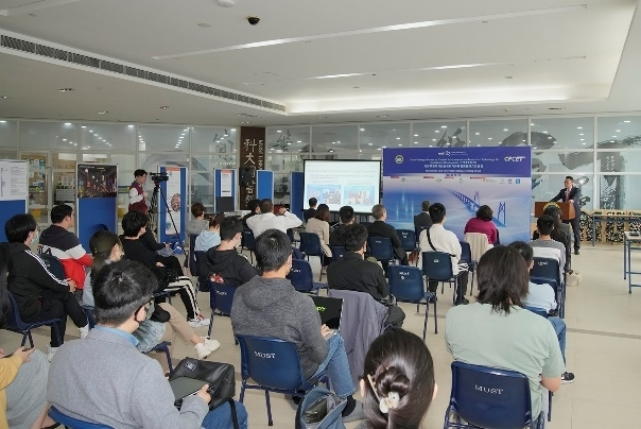
The forum connects academia and relevant industries through keynote speeches and exchange activities

